Time Blocking with ADHD: Why visual planning works
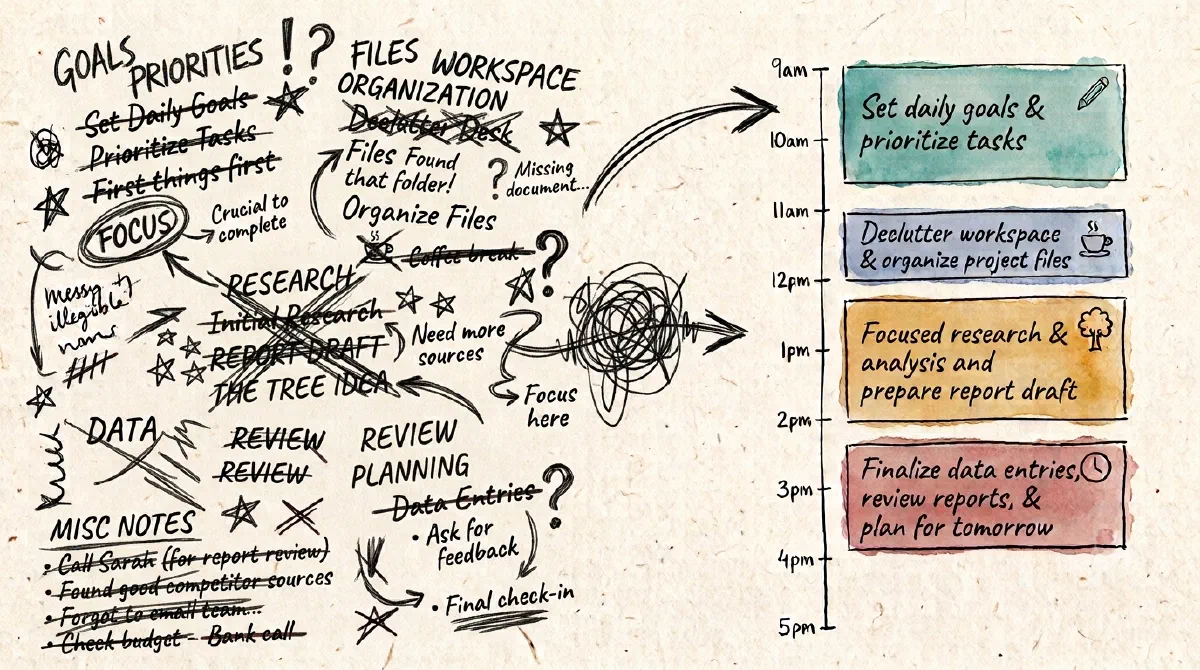
You look at your task list. Six items:
- Write the email
- Finish the proposal
- Call the dentist
- Review the PR
- Fix the bug
- Pick up groceries.
You’ve been here before. The list is fine. The list is always fine.
What you can’t tell from the list is whether those six things take two hours or eight. The email might be a quick reply or a three-round negotiation. The bug might be a typo or a four-day rabbit hole. The list doesn’t say. So you start on the email, and somewhere around 2pm you realize the morning is gone and you’ve done one item, and the other five now feel impossible. Not because they are impossible. But because the list never told you what it cost.
This is the part of ADHD people call time blindness, and it’s the part most productivity advice seem to get wrong.
Time blindness is not laziness
Time blindness is a perceptual problem. Studies have found measurable differences in how ADHD brains process time.1 It’s not a lack of caring or effort. Your brain underestimates how long things take and overestimates how much fits in a day. It’s not a character flaw. It’s not that you don’t care about being on time. The internal clock that tells most people “this will take 45 minutes” just runs differently for you.2
The result is a specific kind of mismatch. You plan as if you have more time than you do, then feel like a failure when reality catches up. The plan was always unrealistic. You just didn’t know.
A lot of ADHD advice treats this as a willpower problem. Try harder. Use stricter calendars. Set more alarms. But the issue isn’t effort. It’s that the tools you’re using to plan don’t show you time the way your brain needs to see it.
Why calendars and to-do lists both fail
A calendar shows time but hides scope. You block 10 to 11 for “deep work” and discover at 10:55 that the work needs two more hours. Now you have a choice: break the calendar or break the plan. Most people break the plan, feel bad about it, and stop trusting the calendar.
A to-do list shows scope but hides time. You have twelve items and no idea if that’s a light day or an impossible one. The list rewards checking things off and punishes you for the things that roll over. Every unfinished item is a small debt you carry forward.
Both tools share the same flaw. They assume you know how long things take before you start. If you have time blindness, you don’t.3 And neither tool lets you fix that assumption once you’re proven wrong.
Time blocks solve a different problem
A time block is a task with a start time and a duration. When you realize a task needs more time, you change the duration and the schedule shifts. You don’t erase the plan. You edit it in place.
This matters for ADHD brains for a few reasons.
You can see time. A list of six tasks is abstract. Six tasks on a day, each with a real duration and a real time slot, is concrete. You can tell at a glance whether the day is full or half empty. The question “is this too much for today” stops being a guess. This is also why visual timers and structured time aids work so well for ADHD: they take time out of your head and put it where you can see it.4
You can be wrong without guilt. The plan is not a contract. When the 45-minute task needs 90, you change the duration and move on. The schedule adapts. You don’t have to admit the plan failed, because the plan didn’t fail. It updated. That distinction sounds small until you’ve spent years feeling like every planner is a record of your shortcomings.
Replanning is the work, not a sign you did it wrong. ADHD days go off the rails. Things take longer. Interruptions happen. A tool that expects you to stick to the plan will fail by design. A tool that expects you to replan all day works with your brain instead of against it.
How to actually use time blocking with ADHD
A few things I’ve found matter more than the rest.
Start with three blocks. Not the whole day. Three blocks for the three things that actually matter. If you fill the day on Monday morning, you’ll abandon it by lunch. Leave everything else as unscheduled space. You can always add blocks later. Adding feels like progress. Removing feels like failure.
Leave buffers. People with ADHD underestimate time by about 50% more than most people, so if you think something takes an hour, block 90 minutes.5 If you finish early, you have a gift of time, which is a better feeling than running over. The buffer is not wasted space. It’s the difference between a plan that survives contact with the day and one that doesn’t.
Don’t schedule every minute. A fully packed day has no slack, and no slack means the first interruption breaks everything. Leave gaps. The gaps are where the unplanned stuff goes, because unplanned stuff will happen.
Expect to replan. This is the part that trips people up. You will move things around. You will change durations. You will delete some and add others. That is not a failure of the system. That is the system. If your planner can’t handle mid-day edits, it’s the wrong planner for an ADHD brain. (The same thing happens to non-ADHD planners, just slower. See why your day plan breaks.)
One task per block. Not “email and Slack and the proposal.” Just the proposal. If the block is too big, you’ll avoid starting it. Small blocks are easier to start, and starting is the whole battle.
The tool is less important than the approach
You can do this on paper. You can do it in a calendar app that lets you move things around. The specific tool matters less than the three properties: you can see time as durations, you can adjust when you’re wrong, and replanning doesn’t punish you.
I built Time Blokker because I wanted all three without a subscription and without an account. The app is one option. The approach is what counts. If time blocking helps you plan the kind of day that actually survives past lunch, use whatever tool lets you do that. The goal was never a perfect plan. The goal was a plan you can trust, edit, and stop feeling guilty about.
Time Blokker is available on iOS and Android, pay once, no subscription.
Barkley, R. A. (1997). “Attention-deficit/hyperactivity disorder, self-regulation, and time: toward a more comprehensive theory.” Journal of Developmental & Behavioral Pediatrics, 18(4), 271-279. ↩︎
Weissenberger, S., et al. (2021). “Time Perception is a Focal Symptom of Attention-Deficit/Hyperactivity Disorder in Adults.” Medical Science Monitor, 27. ↩︎
Mette, C. (2023). “Time Perception in Adult ADHD: Findings from a Decade: A Review.” International Journal of Environmental Research and Public Health, 20(4), 3098. ↩︎
Rademacher, J., et al. (2017). “Effectiveness of time-related interventions in children with ADHD aged 9-15 years: a randomized controlled study.” PMC5852175. ↩︎
A 2024 meta-analysis across 824 effect sizes found a medium-to-large deficit (g = 0.688) in time perception among people with ADHD. Developmental Neuropsychology, 49(1). ↩︎