Why your day plan breaks (and how to fix it)
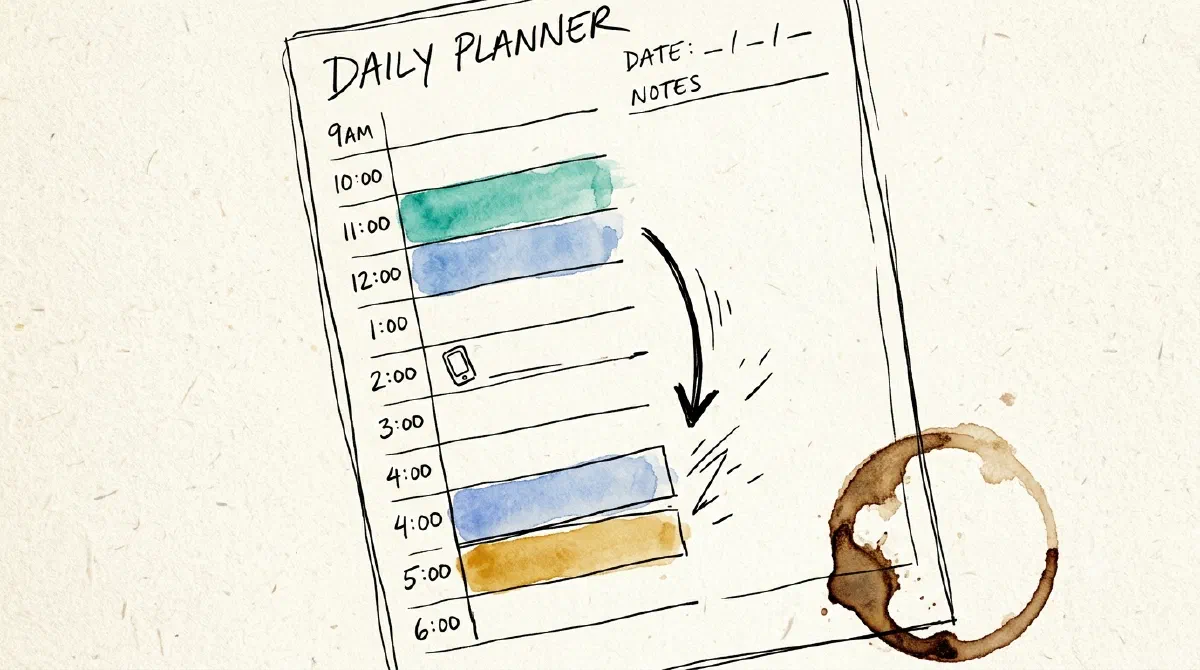
You time-blocked the whole day. Ninety minutes for the proposal, a short break, then client work until lunch, then the bug list in the afternoon. You felt good looking at it. Twenty minutes in, a call comes in. “Just fifteen minutes,” they say.
Forty-five minutes later you hang up. The proposal slot is gone. The break is gone. Everything after it is now wrong by forty-five minutes, and every block on the screen is a small accusation. You cross out the timings and redo them by hand. Or you drag each calendar entry down, one by one, until the plan looks honest again.
The next day, the same thing happens. The day after, you stop planning altogether.
I built a planning app because I kept living this. Not because I read a book about productivity, but because I got tired of abandoning my plan by 10am and then pretending the rest of the day was going fine.
Calendars are built for meetings, not tasks
Most calendars are brittle. They were built for meetings, which are fixed things negotiated with other people. You can’t move a 2pm call to 2:45 because you felt like it. The other person has to agree.
Tasks aren’t like that. A task is fluid. It runs long, it finishes early, it gets interrupted, it turns out to be twice the work you expected. Stuffing tasks into a calendar designed for meetings is like storing groceries in a filing cabinet. It sort of works, until it doesn’t.
What happens when a plan breaks
There’s research on this. Polivy and Herman called it the “what the hell” effect. They were studying dieters when they found it. When someone broke their diet, they didn’t just compensate and move on. They abandoned the whole thing. “What the hell, my diet is already broken, may as well keep eating.” Not the deviation itself, but the feeling of lost control. Once your plan is off by fifteen minutes, your brain treats it as already failed. You stop trying to recover and start winging it.1 Cochran and Tesser later showed the same thing happens with any goal, not just eating. Including your day plan.
The cost isn’t the fifteen minutes. The cost is the three hours of unfocused work that follow, because you decided the plan was dead so why bother.
There’s also the planning fallacy, which is the tendency to underestimate how long tasks will take. People plan as if everything will go smoothly, ignoring everything they know about how their days actually unfold.2 So the plan isn’t just brittle. It was built on a bad estimate from the start.
I think this is why so many people quit time-blocking after a week. Planning isn’t the problem. The plan has no give, so the first disruption takes the whole thing down.
How to build a day that survives
A resilient day is one that can absorb a hit and keep going. Here’s what I’ve learned, mostly by getting it wrong first.
Find the fixed points. Meetings, lunch, the school run, your workout. These don’t move. Put them in first. Everything else is negotiable and has to fit around them. If you don’t know what’s actually fixed, you’ll plan as if nothing is, and then one meeting at 2pm will silently capsize your whole afternoon.
Put buffer between blocks. Back-to-back planning feels productive on paper and falls apart in practice. A task runs ten minutes long and the next one starts late and the one after that starts later. Give each block a little room. If nothing slips, you get a bonus break. If something slips, the plan absorbs it without breaking.
Plan your breaks. I used to skip this. Big mistake. Breaks are the first thing to disappear when the day gets tight, and the lack of them is the first thing that makes you hate the plan by 3pm. A five-minute stretch and some water isn’t laziness. It’s what lets the next hour actually be useful.
Use a tool that moves with you. This is the part I care about, because it’s why I built Time Blokker. When a task runs long, everything below it should slide down on its own, around the fixed events that can’t move. You shouldn’t have to rebuild the plan by hand every time something changes. The plan should adapt. If it doesn’t, you’ll stop trusting it, and once you stop trusting it, you stop using it. (If you’re shopping around, I wrote up how Time Blokker compares to Structured — the difference comes down to exactly this.)
The whole thing
A plan you trust is a plan you’ll keep. A plan that breaks on the first disruption is a plan you’ll abandon by Wednesday.
If your day keeps falling apart and you’re tired of replanning by hand, Time Blokker is built for exactly this. Drag a task, watch the rest adjust. Free to try, pay once, no account, no subscription. Available on iOS and Android.
Polivy, J., & Herman, C. P. (1985). “Dietary restraint and the ‘what-the-hell effect.’” In Goal Violations and Behavior. A small deviation from a plan causes people to abandon the goal entirely rather than recover. The effect has since been replicated across goal domains beyond dieting. ↩︎
Buehler, R., Griffin, D., & Ross, M. (1994). “Exploring the ‘planning fallacy’: Why people underestimate their task completion times.” Journal of Personality and Social Psychology, 67(3), 366-381. ↩︎