The problem with to-do lists (and what to do instead)
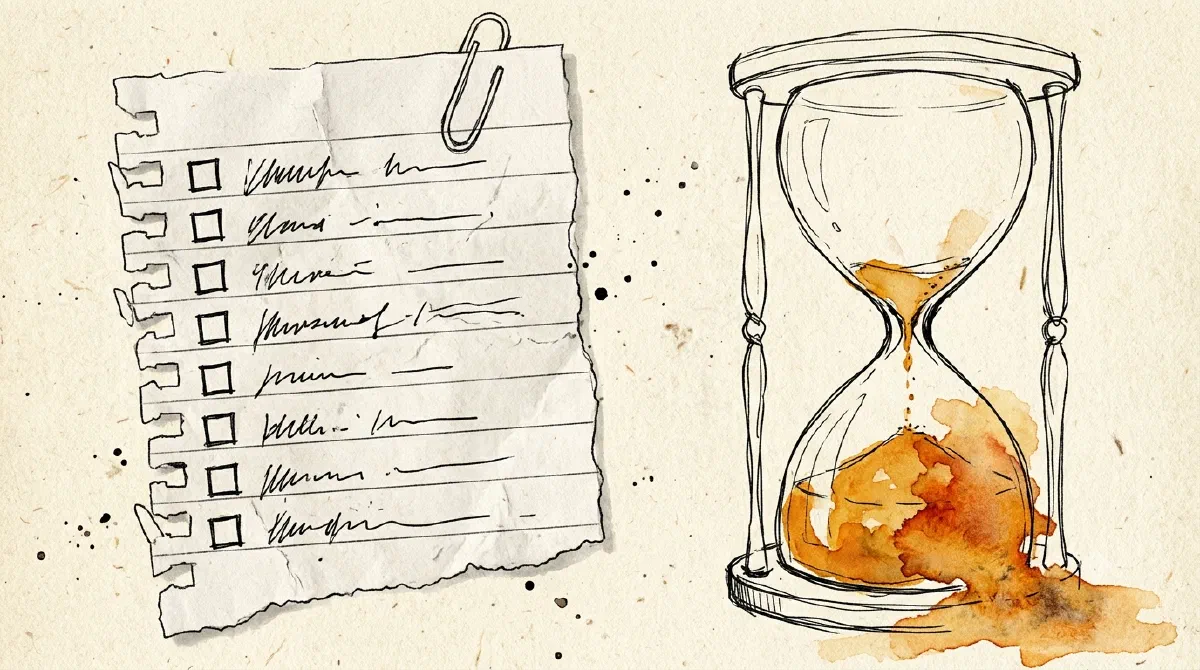
Eight items on your to-do list. Looks manageable. You’ll knock it out.
But one of those items takes three hours, and you’ve got four hours left today. Another takes 90 minutes. Two more take an hour each. The list never mentioned any of that. It just showed you eight lines and let you believe eight lines meant eight quick things.
This is the core problem with to-do lists, and it took me years to see it clearly: a list has no time dimension. It counts tasks, not minutes. Eight items could be 40 minutes of work or 12 hours, and the list presents both the same way.
Why to-do lists feel productive but aren’t
Crossing things off feels good. That little hit of progress is real, and it’s why people stay loyal to the format for years. But the feeling is disconnected from whether you’re getting the right things done.
Here’s what a to-do list can’t tell you:
- Whether the day is overcommitted before you start
- Which task eats most of your afternoon
- That the quick wins you crossed off at 10am weren’t the work that mattered
- That the big task you saved for “later” never had a later, because there was no later left
You finish the day having crossed off six of eight items and feel productive. The two you didn’t touch were the ones that actually mattered, and you never stood a chance because nobody, including the list, checked whether they fit.
A list optimizes for completion, not for capacity. It rewards you for doing the easy stuff first.
The “duration blindness” problem
Even if your to-do list tried to show time, you’d be bad at reading it. People are systematically terrible at estimating how long things take. Not a little off. Off by half or more, consistently, across every study that’s measured it.1 For people with ADHD this is time blindness, not laziness, the same effect, dialed up.2
I do this every week. I write “write the landing page” and think 45 minutes. It takes two and a half hours. I write “fix the bug in checkout” and think 30 minutes. It takes the rest of the afternoon. This isn’t a discipline problem. It’s how human brains work. We plan the version of the task that exists in our head, not the one that exists in the code, the document, the conversation that needs to happen first.
A to-do list makes this worse because it strips the time question entirely. The list says “fix the bug” and you say “sure.” There’s no friction. No moment where the tool says “okay, but when?” The result is a plan that looks reasonable and was never possible. (This is also why your day plan breaks — the plan was fiction before you started, not after.)
What to do instead
Give every task a duration. Then stack them against the hours you actually have.
That’s the whole change. You stop running off a flat list and start running off something that lives in time. If you’ve never done that before, time blocking for beginners walks through the simple version in five minutes.
When you put “write the proposal, 2 hours” next to “reply to Marc, 15 minutes” next to “lunch, 1 hour,” something visible happens. You can see the proposal eating a third of your morning. You can see that the two meetings at 2 and 3 leave you 45 minutes before the school run, not “the afternoon.” The day stops being an abstract pile of intentions and becomes a physical thing with edges.
Most days, the first time you do this, you’ll find the day is already full by lunch. That’s not a failure of the method. That’s the method working. It just told you something the to-do list spent years hiding: you don’t have as much room as you thought.
From there you get to make a real choice. Drop something, move it to tomorrow, or accept that something slips. The choice is informed instead of imaginary.
The tool question
I built Time Blokker because I kept hitting this exact wall. A flat list, a calendar next to it, and a gap between the two I couldn’t see. So the app gives every task a real duration, drops it on a day timeline, and shows you what fits. You drag things around, the day shifts, and “overcommitted” becomes visible before 3pm instead of after. If you want the side-by-side with the other popular option, I wrote up how Time Blokker compares to Structured.
But the concept matters more than the tool. You can do this with a paper planner. You can do it with the calendar app already on your phone. The point isn’t the app. The point is that your tasks need to live in time, not in a list, because a list will let you plan a day that was never going to fit.
If you’ve been running off to-do lists for years and ending most days feeling busy but not done, this is probably why. The list was never showing you the thing you needed to see.
Buehler, R., Griffin, D., & Ross, M. (1994). “Exploring the ‘planning fallacy’: Why people underestimate their task completion times.” Journal of Personality and Social Psychology, 67(3), 366-381. People consistently underestimate task duration by 50% or more, even when they have experience with similar tasks. ↩︎
A 2024 meta-analysis across 824 effect sizes found a medium-to-large deficit (g = 0.688) in time perception among people with ADHD. Developmental Neuropsychology, 49(1). ↩︎