Why your 30-minute task takes two hours (and how to plan around it)
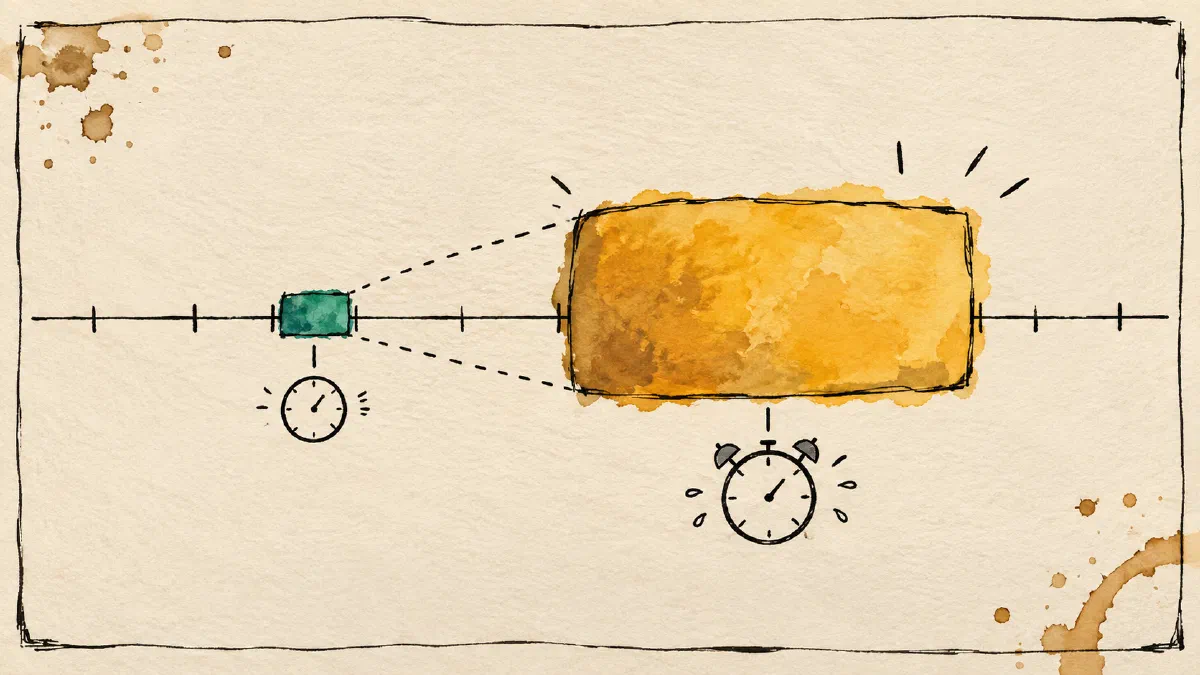
“Write the article. Forty-five minutes, tops.”
Two and a half hours later, you have half an article and a plan that’s been wrong since 9:15. If this happened once, you’d call it bad luck. But it happens every week, to nearly everyone, and it has a name: the planning fallacy. People underestimate how long tasks will take, by half or more, even when they’ve done the same task before and been wrong the same way.1
This isn’t a discipline problem. Knowing about the planning fallacy doesn’t protect you from it, which is the annoying part. Roger Buehler, the psychologist who ran the original studies, found that students who were explicitly warned about it still underestimated their thesis deadlines by weeks. You can’t out-willpower a cognitive default. You can only plan around it.
Why your brain lies to you
When you estimate “write the article,” your brain retrieves the ideal version of the task: you, focused, at a clean desk, typing steadily. It doesn’t retrieve the real version: the fifteen minutes finding the draft, the messing with the formatting, the Slack ping in the middle. The part where you reread your own first paragraph and hate it.
Every task has a hidden second task attached, and the hidden one is usually the bigger one. “Fix the bug” is twenty minutes of fixing and an hour of finding. “Quick call” is first reading up on the documents. Time estimates are made against the visible task, not the actual tasks behind it.
There’s also the “finish line sprint” illusion: we estimate based on how long the work takes at full speed, not at the speed an actual Tuesday afternoon allows. Multiply by the number of interruptions your Tuesdays usually contain. That’s the real number.
The fix is structural, not moral
The standard advice is “estimate better,” which is like telling someone with a bad sense of direction to navigate better. The fixes that actually work change the structure of the plan instead:
Double it, or at least 1.5x it. The simplest correction and the one I usually use. Write the estimate you believe, then multiply by 1.5 for familiar work and 2 for anything new. You’ll be right more often than you’ll believe. The irritation you feel at the increased number is your planning fallacy trying to defend itself.
Plan the hidden second task. “Write the article” becomes “find assets + draft copy.” “Fix the bug” becomes “reproduce the bug.” Naming the hidden task drags its duration into the estimate where it belongs.
Put buffer in the day, not just in the blocks. A fully packed day is a plan with zero slack, which means the first overrun breaks it, and a broken plan doesn’t get repaired, it gets abandoned. Leave real gaps between blocks. If nothing runs over, you get the time back. If something does, the plan absorbs it instead of dying.
Track it for two weeks. Write your estimate down, then write down what actually happened. Two weeks of that will recalibrate you more than any productivity book, because you’ll finally have evidence instead of vibes. Most people discover their “30 minutes” is 80. I did.
Plan at the speed of your actual day, not your best one. If you’re planning a schedule that only works if nothing goes wrong, you haven’t planned a day. You’ve written fiction with a timeline.
Where the tool matters
A to-do list can’t help you here at all. It doesn’t show duration, so the bad estimate never gets challenged by the physical limits of the day. A calendar forces your bad estimate into a fixed rectangle, and then it’s wrong all afternoon.
A day timeline with durations does the one thing that actually fights the fallacy: it makes the overcommitment visible before you start. When your doubled estimates don’t fit between the fixed events, you see it at 8am and make a real choice, instead of discovering it at 3pm and making an exhausted one.
That’s the mechanic I built Time Blokker around. I kept planning days that only worked if nothing ran over. Every task has a duration, and when one overruns, the rest of the day shifts around it. You can find it on iOS or Android.
But the two-week estimate journal also works on paper, and it’s the most useful thing on this list. Start there.
Buehler, R., Griffin, D., & Ross, M. (1994). “Exploring the ‘planning fallacy’: Why people underestimate their task completion times.” Journal of Personality and Social Psychology, 67(3), 366-381. People underestimate completion times by around 50%, even with experience of the same task and awareness of the bias. ↩︎